Hammernik’s 2015 Tax Time Document Chase List

Dale Hammernik • February 2, 2015

Well, our offices have officially started jumping.

(Not literally , of course.)

The IRS started accepting electronically-filed returns about two weeks ago, and we have already been working long hours to thoughtfully and thoroughly serve the clients with whom we’ve already met.

Today, I have something that will help that be YOU.

As I’ve mentioned before, if you are one of our business clients, we are also glad to handle the preparation of your personal tax return. Depending on your business entity, we may not be able to file your personal return until your books are in order. Start that process now.

[And, of course, this is also something we are glad to help you with. Don’t try to “go it alone” in these areas … it can be a 4-5 figure mistake!]

Filing your taxes on your own is becoming much less fun for regular taxpayers, even with nice-looking softwares on the market which purport to make it “easy” for you. This is ESPECIALLY true for business owners.

I truly do pity those inexperienced ones who try to muddle through all of the different codes and forms on their own, without devoting even a week’s labor to the transaction. It really doesn’t pay to “go it alone” for certain tasks.

So, I’ve put together a handy little list of what you’ll need to bring in, which is something I make a point to provide each year. There may be certain situations where we’ll need other documentation to get you even more deductions. But, of course, we’ll let you know about that, should the situation arise!

Let me know your thoughts … and of course, if you’d like to talk this over with us, we’re here for you: (414) 545-1890 (our phone number) is your friend.

Hammernik’s 2015 Tax Time Document Chase List
“My ability to concentrate and work toward that goal has been my greatest asset.” – Jack Nicklaus

Yes, this is a long list — but it’s the unfortunate reality of our tax code that it’s not even comprehensive! But these items will cover 95% of our clients. Really, this is for ensuring that we’re able to help you keep every dollar you can keep under our tax code.

Even if for some strange reason you won’t be using our cost-effective services this year, feel free to use this list as a handy guide…

Personal Data
Social Security Numbers (including spouse and children)
Child care provider tax I.D. or Social Security Number

Employment & Income Data
W-2 forms for this year
Tax refunds and unemployment compensation: Form 1099-G
Miscellaneous income including rent: Form 1099-MISC
Partnership and trust income
Pensions and annuities
Alimony received
Jury duty pay
Gambling and lottery winnings
Prizes and awards
Scholarships and fellowships
State and local income tax refunds
Unemployment compensation

Health Insurance Information (New for 2015)
* All 1095-A Forms from marketplace providers (if you purchased insurance through a Marketplace)
* Existing plan information (policy numbers, etc.)
* If claiming an exemption, your unique Exemption Certificate Number
* Records of credits and/or advance payments received from the Premium Tax Credit (if claiming)

Homeowner/Renter Data
Residential address(es) for this year
Mortgage interest: Form 1098
Sale of your home or other real estate: Form 1099-S
Second mortgage interest paid
Real estate taxes paid
Rent paid during tax year
Moving expenses

Financial Assets
Interest income statements: Form 1099-INT & 1099-OID
Dividend income statements: Form 1099-DIV
Proceeds from broker transactions: Form 1099-B
Retirement plan distribution: Form 1099-R
Capital gains or losses

Financial Liabilities
Auto loans and leases (account numbers and car value) if vehicle used for business
Student loan interest paid
Early withdrawal penalties on CDs and other fixed time deposits

Automobiles
Personal property tax information
Department of Motor Vehicles fees

Expenses
Gifts to charity (receipts for any single donations of $250 or more)
Unreimbursed expenses related to volunteer work
Unreimbursed expenses related to your job (travel expenses, entertainment, uniforms, union dues, subscriptions)
Investment expenses
Job-hunting expenses
Education expenses (tuition and fees)
Child care expenses
Medical Savings Accounts
Adoption expenses
Alimony paid
Tax return preparation expenses and fees

Self-Employment Data
Estimated tax vouchers for the current year
Self-employment tax
Self-employment SEP plans
Self-employed health insurance
K-1s on all partnerships
Receipts or documentation for business-related expenses
Farm income

Deduction Documents
State and local income taxes
IRA, Keogh and other retirement plan contributions
Medical expenses
Casualty or theft losses
Other miscellaneous deductions

We hope this helps, and we really look forward to seeing you in here in 2015!

Feel very free forward this article to a Waukesha County business associate or client you know who could benefit from our assistance — or simply send them our way? While these particular articles usually relate to business strategy, as you know, we specialize in tax preparation and planning for Waukesha County families and business owners. And we always make room for referrals from trusted sources like you.

Warmly (and until next week),

Dale Hammernik
(414) 545-1890

Hammernik & Associates

See More Blog Posts

By Brad Tobin November 18, 2025
Most business owners think their Accountant is “handling their taxes.” But here’s the truth; there’s a massive difference between tax preparation and tax planning , and most accountants only do one of them. 1. Tax Preparation: The History Report Tax preparation is what happens after the year is over. Your CPA gathers your numbers, plugs them into software, and files your returns with the IRS. It’s about compliance by making sure everything is accurate and filed on time. It’s not about strategy; once December 31st has passed, there’s very little that can be done to lower your tax bill. Think of it as your financial “history report.” It’s a look back at what already happened. 2. Tax Planning: The Playbook Tax planning is proactive. It’s about designing your financial life to pay less tax before the year ends. It focuses on strategy; entity structure, retirement contributions, income shifting, real estate strategies, depreciation planning, credits, and deductions that fit your situation. It’s done throughout the year , not just in March or April. It creates real savings , not just “clean paperwork.” Tax planning turns your CPA into a coach, someone who helps you make decisions today that reduce what you owe tomorrow. 3. The Key Question to Ask If you only hear from your CPA at tax time, you’re getting tax prep. If you’re meeting throughout the year, reviewing financials, projecting income, and discussing ways to save, that’s tax planning. Ask your CPA: “What are we doing this year to reduce next year’s taxes?” If they don’t have an answer, it’s time to find someone who does. 4. Why It Matters The difference can be tens of thousands of dollars. Tax prep is a cost. Tax planning is an investment, and it usually pays for itself many times over.
By Brad Tobin October 28, 2025
If you own rental property or are thinking about investing in real estate, one of the biggest decisions you’ll make is whether to operate a short-term rental (STR) like an Airbnb or VRBO, or a long-term rental (LTR) with traditional tenants. While both can generate solid cash flow, the tax differences between short-term and long-term rentals can have a major impact on your bottom line, and the IRS treats them very differently. 1. Short-Term Rentals Are Often Treated Like a Business If your average guest stay is seven days or less, the IRS generally doesn’t treat it as a “rental activity.” Instead, it’s often classified as an active trade or business, similar to running a small hospitality operation. Tax implications of short-term rentals: You may owe self-employment tax if you provide substantial guest services (like cleaning during the stay, meals, or concierge-type help). You might qualify for the Qualified Business Income (QBI) deduction, which can allow up to 20% of your profit to be tax-free. Bonus depreciation and Section 179 expensing may apply to furnishings, décor, and equipment. Losses can be used to offset other active income (business or W-2).  In short, short-term rentals can open the door to more tax deductions, but they also come with more complexity and recordkeeping requirements. 2. Long-Term Rentals Are Usually Passive Income For long-term rentals, where tenants sign leases for months or years, the IRS classifies the activity as passive income. Tax implications of long-term rentals: No self-employment tax applies to rental income. You can claim depreciation deductions to offset income and reduce taxes. You may still qualify for the QBI deduction if the rental activity rises to the level of a trade or business. However, losses from long-term rentals are usually passive losses, which can only offset other passive income unless you qualify as a real estate professional. 3. Faster Write-Offs Through Cost Segregation Both short-term and long-term rental owners can use cost segregation studies to accelerate depreciation. By identifying assets such as furniture, flooring, and appliances that can be depreciated over 5 or 7 years, investors can front-load deductions and reduce taxable income in the early years of ownership, a popular Airbnb tax strategy for maximizing cash flow. 4. Choosing the Right Rental Strategy for Tax Savings Both short-term and long-term rentals offer powerful tax benefits but which is best depends on your goals: Choose short-term rentals if you want flexibility, higher income potential, and more deduction opportunities. Choose long-term rentals if you prefer stability, predictable cash flow, and less day-to-day involvement. Before deciding, talk with a CPA who specializes in real estate taxation. The right setup can help you maximize deductions, reduce your tax liability, and avoid costly mistakes. Short-term and long-term rentals both build wealth, but the tax rules are not one-size-fits-all. Understanding how the IRS classifies your rental activity is key to keeping more of what you earn. If you’re not sure which approach offers the best tax advantage, get professional advice before you buy or convert a property. A well-structured strategy could save you thousands each year.
By NICHOLAS HAMMERNIK October 8, 2025
Unlock the Strategic Path to Tax Savings
By Brad Tobin October 1, 2025
The One Big Beautiful Bill Act has reshaped tax law in ways that directly affect real estate investors. While many changes apply broadly to business owners, real estate stands out as one of the biggest winners, with some important caveats. Here’s what you need to know: 1. 100% Bonus Depreciation is Permanent One of the most valuable tools for real estate investors has been bonus depreciation, allowing immediate write-offs of certain improvements and property components. The new bill makes 100% bonus depreciation permanent. What this means: Cost segregation studies remain a powerful way to accelerate deductions. Investors purchasing or improving property over the next few years can still capture large up-front tax benefits. 2. 1031 Exchanges Fully Preserved There was speculation that like-kind exchanges (1031s) might be curtailed or eliminated. The new law instead fully preserves 1031 exchanges for real estate. What this means: Investors can continue deferring capital gains taxes by rolling proceeds from one property into another. Combined with extended bonus depreciation, this creates opportunities for “swap ‘til you drop” strategies, exchanging property while deducting improvements and eventually receiving a step-up in basis at death. 3. Opportunity Zone Changes Opportunity Zones (OZs), designed to incentivize investment in designated low-income areas, saw important updates under the new law. What changed: The program sees a new 5 year rolling deferral period starting on January 1, 2027, giving investors more time to deploy capital and meet compliance deadlines with basis step ups. What this means: Investors sitting on capital gains still have a chance to defer and potentially reduce those taxes by investing in Qualified Opportunity Funds in 2027. Longer timelines mean more flexibility in planning, but reporting compliance will become more important. 4. Energy-Efficient Provisions Narrowed Under prior law, energy-related credits and deductions had expanded significantly. The new bill rolls some of these back, especially for residential projects, while still preserving limited opportunities for commercial property. What changed: Section 179D (commercial building energy-efficiency deduction) & 45L (new energy efficient home credit) is preserved, but only through June 30, 2026 for projects that begin construction before then. After that, it phases out. Many residential energy credits (solar, HVAC, insulation) are being eliminated or sunset after 2025. Commercial Battery Storage Credit is still available through 2032 and will start to phase out in 2033 and 2034. What this means: Commercial property owners considering efficiency upgrades should act soon there is a clear window of opportunity before these provisions disappear. Residential investors should not rely on tax credits for green improvements going forward. The One Big Beautiful Bill Act creates new opportunities but also deadlines for real estate investors. Extended bonus depreciation and preserved 1031 exchanges keep powerful tax strategies on the table. Opportunity Zones have been given new life, while energy-efficient incentives are on the clock. The key takeaway: timing matters more than ever. Planning acquisitions, improvements, and sales with these changes in mind can mean the difference between maximizing tax savings or missing out. If you’re a real estate investor and want to understand how these provisions apply to your portfolio, let’s connect to review your specific situation.
By Brad Tobin September 23, 2025
In July 2025, Congress passed and the President signed into law the One Big Beautiful Bill Act (OBBBA), bringing major changes to the U.S. tax code that significantly impact businesses, investors, pass-through entities, and estate planning. Many provisions build on the Tax Cuts and Jobs Act (TCJA). Some are permanent, others temporary, and all require careful planning to maximize opportunities and avoid pitfalls. If you are a business owner, investor, or considering succession or estate planning, these changes could affect you directly. Key Business & Investment Tax Changes QBI Deduction Made Permanent ● 20% deduction for pass-through entity income (LLCs, S-corps, partnerships, sole proprietorships) is now permanent. ● Income thresholds for specified service trades or businesses (SSTBs) increased for 2025 ($394,600 for joint filers and $197,300 for other taxpayers). ● Starting in 2026, phase-in ranges expand: $150k for joint filers and $75k for others. ● Taxpayers with at least $1,000 in QBI may claim a minimum $400 QBI deduction. 100% Bonus Depreciation Permanently Extended ● Businesses can fully deduct qualifying property (equipment, vehicles, and certain buildings) placed in service after Jan 19, 2025. ● Manufacturing buildings qualify if placed in service before Jan 1, 2031. Qualified Opportunity Zones (QOZs) ● Program is now permanent, with new 10-year designations beginning Jan 1, 2027. Estate, Gift, and Succession Planning ● Lifetime estate and gift tax exemption increased to ~$15 million per person (indexed for inflation beginning in 2026). ● Adjustments to Qualified Small Business Stock (QSBS) for shares issued after July 4, 2025. Tip Credit Expansion ● FICA tip credit extended to beauty service businesses. Other Key Provisions ● Restored Research and Development expensing (Section 174). ● Interest deduction changes (ATI excludes depreciation, amortization, or depletion). ● Higher Section 179 deduction and phase-out thresholds. ● Expanded Low Income Housing Tax Credit allocations. ● Clean Energy Tax Credit changes: Section 45L and 179D repealed after June 30, 2026. Considerations & Challenges ● Some provisions are temporary (e.g., certain deductions and caps), so timing is critical. ● Income phaseouts may limit benefits for high-income pass-through owners. ● Increased compliance complexity (e.g., amended returns, documentation) will be important. ● Real estate ownership structures and financing choices may need reevaluation in light of new depreciation and interest rules. Planning Opportunities for Businesses & Investors Accelerate Capital Expenditures Investing in equipment, vehicles, or eligible buildings now can provide immediate tax benefits through 100% bonus depreciation. Optimize Business Structure for QBI Assess ownership, entity type, and income levels to maximize the 20% deduction. Service businesses might gain advantages by restructuring to distinguish between qualifying and non-qualifying activities. Estate & Succession Planning Take advantage of the higher exemption to transfer assets via gifts or trusts while the thresholds are still beneficial. Consider Qualified Small Business Stock (QSBS) opportunities if you are investing in or selling small business shares. Leverage Tax Credits & Incentives Investigate possibilities in affordable housing and Qualified Opportunity Zones, but ensure compliance with updated documentation requirements. Cost Segregation for Real Estate Think about conducting cost segregation studies to enhance depreciation benefits on properties. Model Income Scenarios Create multi-year projections to optimize the timing of income, deductions, and asset acquisitions to avoid crossing phaseout thresholds. What’s Next? The One Big Beautiful Bill Act transforms the tax environment for businesses and investors alike. Featuring permanent QBI deductions, reinstated R&D expensing, and bonus depreciation, it unlocks extraordinary chances to minimize taxable income. Additionally, enhanced estate and gift exemptions offer robust strategies for effective succession planning. However, these advantages won’t maximize themselves. Considerations such as timing, entity structure, and integrated planning are crucial — as every choice can significantly alter your tax responsibilities. To understand how these developments affect your unique circumstances, reach out to us at Hammernik & Associates. Together, let’s devise a strategy that strategically positions your business for success in 2025 and beyond.
By NICHOLAS HAMMERNIK September 17, 2025
Thinking about selling your business? Learn when and how to plan your exit, maximize value, minimize taxes, and prepare for a smooth transition.
By NICHOLAS HAMMERNIK September 4, 2025
Discover the truth about S Corporations. Learn common myths, why they’re often misused, and how Hammernik & Associates reviews entities annually.
By NICHOLAS HAMMERNIK August 28, 2025
Discover the difference between forward-looking and backward-looking accounting—and why combining both helps business owners stay compliant and competitive.
By NICHOLAS HAMMERNIK August 20, 2025
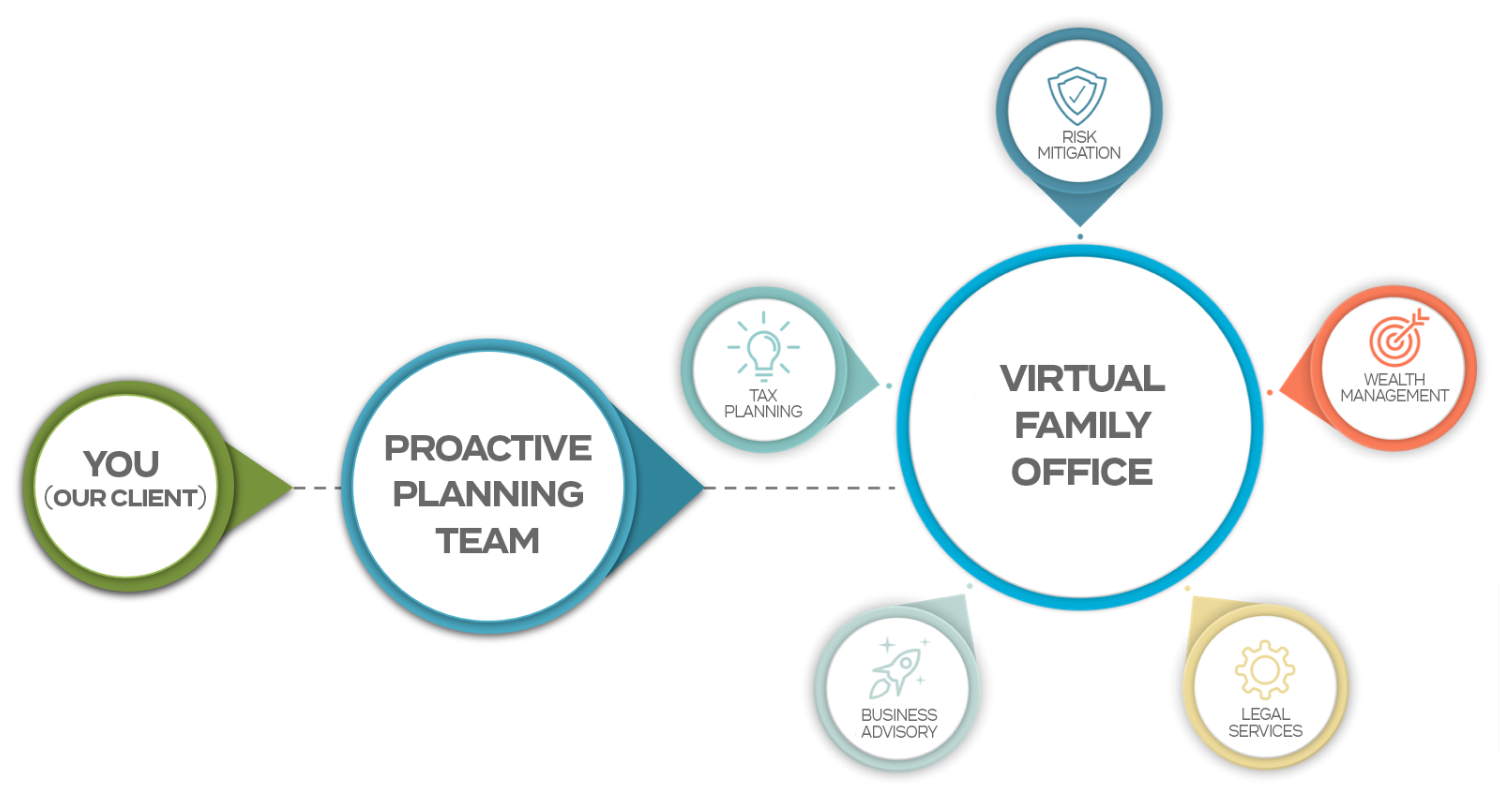
Learn what a Virtual Family Office is and how it provides tax, wealth, and business planning strategies once reserved for the ultra-wealthy.
By nicholas December 24, 2020
The “rescue package” has arrived. The COVID Relief bill is a whopping 5,593 pages long. I know you don’t want to sit and read through that novel, so I am here to summarize, in plain English, how this bill is going to effect your taxes. Have you ever been on a roller coaster before? A… The post The COVID Relief Bill Summarized appeared first on Talking Tax to Milwaukee.